How Engineering Principles of Industrial Sewing Threads Prevent Failure in Manufacturing
Industrial sewing is often misunderstood outside the factory. Many see it as a craft, a finishing touch, or a decorative detail. In reality, thread selection is a core engineering decision that has a direct effect on production throughout, machine uptime, seam durability, product reliability, and overall manufacturing costs. A high-quality textile or leather can still fail if the seam is weak – because the seam is the structural interface holding the components together. Once the seam fails, the entire product fails.
Factories that treat thread as a simple commodity often spend more time troubleshooting machine stoppages, replacing needles, adjusting tension, and correcting operator errors than they realize. On the other hand, factories that treat thread as an engineered input – chosen for its load capacity, friction characteristics, compatibility with substrates, and performance at production speed – see lower reject rates, cleaner seams, predictable stitch geometry, and higher overall efficiency. AmandaThreads provides engineered threads designed to deliver consistent performance for demanding industrial environments.
Learn more: Industrial Threads
Why seams fail in production
When a factory examines failed products, the surface material is often the first suspect. But the real reason usually lies in the seam. A seam is not decorative – it is a structural component. Its ability to distribute force across the joint determines the product’s reliability. In high-speed production, factors such as machine velocity, fabric variability, needle temperature, friction, bending, and operator adjustments create stress concentrations that can cause thread failure long before the product reaches the end user.
Each instance of a broken thread or fuzzy stitch disrupts production. Stoppages, wasted materials, quality inspections, and machine resets add real, measurable cost. Yet many manufacturers overlook these costs when selecting thread, focusing only on unit price rather than the broader impact on output and efficiency.
Industrial sewing as a mechanical process
High-speed sewing is fundamentally a frictional process. Every needle penetration interacts with the fabric, tensioning system, presser foot, and bobbin mechanism. At 3,000 – 7,000 rpm, a needle punctures the material thousands of times per minute, generating significant frictional heat. This can break or weaken low-quality threads, create uneven loops, or fuzz the fibers, ultimately compromising stitch geometry. In industrial environments, these minor issues translate directly into downtime and waste.
Thread strength alone is not enough. A high-strength thread that does not perform reliably under friction, bending, or heat is a liability. Industrial sewing threads must balance tensile strength with abrasion resistance, dimensional stability, and compatibility with both the machine and substrate.
Core threads vs other thread types
In high-demand production, core threads outperform spun or textured alternatives because they separate load-bearing capability from surface protection. A strong filament core carries mechanical stress, while the sheath deflects abrasion and friction damage. This design reduces needle friction, stabilizes stitch formation, and extends thread life.
By standardizing on core threads, factories achieve predictable performance, reduced downtime, and smoother operation across production lines. Delta and Ester threads are engineered for these environments, each addressing specific manufacturing challenges.
Application-driven thread performance
Thanks to both the thread and core being polyester, Ester threads excel in environments with high mechanical stress and repeated bending. Footwear, reinforced apparel, luggage, and even furniture require threads that endure thousands of flexing cycles without fracturing. Ester maintains tension and geometry under dynamic load, ensuring seams hold even under constant stress. Factories choose Ester not because it is strong on paper, but because it minimizes production failures and increases line efficiency.
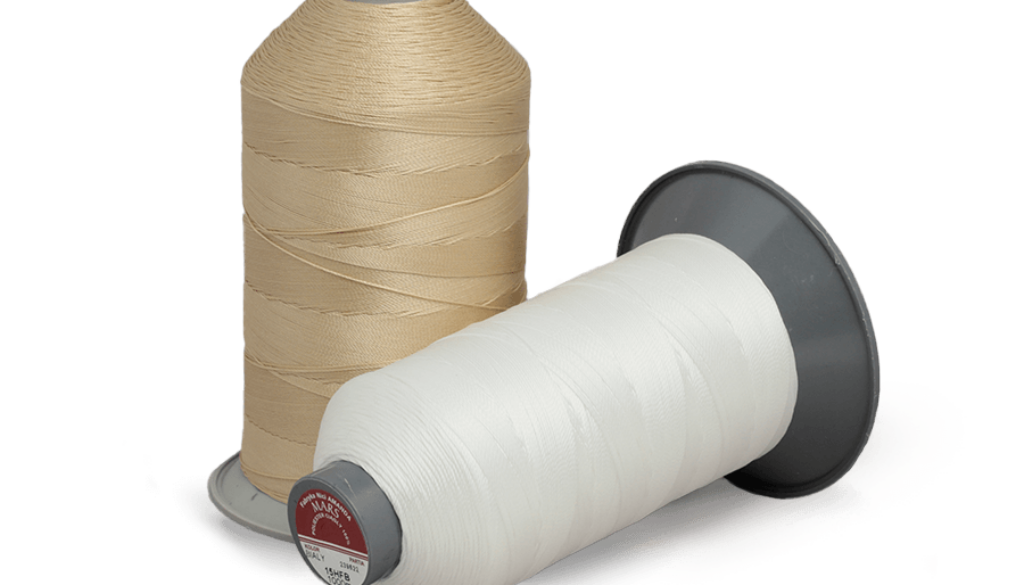
Mars threads are engineered for very high tensile strength, dimensional stability, and reliable high-speed production. In automotive interiors, furniture, and seating manufacturing, seams are exposed to constant mechanical loads while production lines demand uninterrupted operation. Thanks to its continuous filament polyester construction and uniform thread geometry, Mars delivers consistent stitch formation, low friction, and stable tension, reducing fuzzing and thread breaks. This allows manufacturers to maintain long, uninterrupted production runs with minimal rejects, even in demanding heavy-duty sewing applications.
Arena threads are designed for versatility and light sewing. Thanks to their balanced price to quality ratio, high availability and a rich colour palette, these perform perfectly with items like: clothes, bedding, and curtains. Arena threads, while light and easy to work with, remain durable and are an excellent choice for hole-punching and use with an overlock.
Thread as a critical production variable
In industrial sewing, thread is not merely a consumable, it is a critical process variable. Needle choice, machine tension, feed rate, and thread characteristics together determine the final seam quality. Variations in any of these factors can compromise output. When production managers focus solely on cost, they risk downtime, defects, and increased labor for corrections. Factories that integrate engineered threads into their process experience more stable lines, fewer interruptions, and higher overall efficiency.
Mixing different brands or types of threads exacerbates variability. Differences in lubrication, surface finish, filament structure, and polymer composition,even among threads with similar specifications – can cause inconsistent performance, needle wear, and line stoppages. Standardizing on a unified thread platform like Delta, Arena, or Mars eliminates these issues, supporting reliable and scalable manufacturing.
Engineering-driven seam optimization
The thread interacts with the machine, the substrate, and the seam design. Stitch density (stitches per inch), substrate flexibility, and seam type all affect performance. Too many stitches can perforate the material and weaken it, while too few reduce seam strength. Different fabrics respond differently to thread tension: leather resists pull, while foam or synthetic composites compress. Choosing the right thread for the right substrate ensures seams distribute stress properly, reducing failures during production and in the field.
Environmental factors also play a significant role. Threads exposed to heat, humidity, UV radiation, or chemicals degrade over time. Even a visually intact seam can lose tensile capacity if the thread material deteriorates under environmental stress. Selecting threads engineered for stability under expected conditions protects both the product and production efficiency.
Compliance and traceability
Industrial buyers must ensure that threads meet regulatory and certification requirements. Certifications are more than marketing – they protect the factory from liability, ensure quality, and provide assurance to clients. AmandaThreads’ industrial threads comply with OEKO-TEX® Standard 100, offering traceable batches and verified chemical safety. Compliance simplifies procurement for OEMs, contract manufacturers, and large-scale industrial operations.
Full certification details: Certificates
Engineering-based selection in practice
By focusing on performance rather than price alone, factories optimize output and reduce rework. Mars threads address high-load and high temperature, bending-intensive applications; Ester threads ensure consistent performance in high-speed production; Arena threads provide a balanced price to quality ratio, easy-of-use along with a rich colour palette. Integrating these engineered threads into your production process leads to predictable outcomes, improved quality, and reduced operational risks.
In essence, industrial threads are not just materials, they are mechanical components. They determine whether the product survives its operational environment and whether the factory meets its production targets efficiently. Treating thread as an engineered component rather than a commodity transforms the manufacturing process from reactive troubleshooting to proactive optimization.
Explore the complete portfolio: Industrial Threads